
WordPress Website Update
WordPress is built using PHP, a server-side scripting language, as its primary programming language. This means that PHP powers the core functionality, themes, and plugins of WordPress. When a user visits a WordPress website, the server runs the PHP code, which then generates the HTML that is displayed in the user's browser.
PHP is possibly one of the most important engine parts keeping your website running!
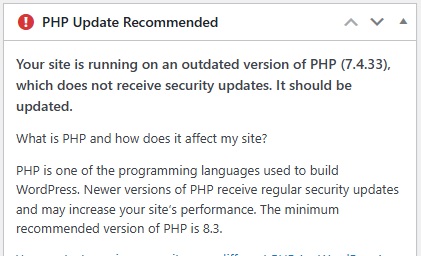
Updating WordPress from PHP 7.4.33 is crucial for security and performance. Why?
Updating from PHP 7.4.33 offers significant advantages, primarily in security, performance, and access to new features. PHP 7.4 reached its end-of-life (EOL) in November 2022, meaning it no longer receives security updates, leaving websites vulnerable to exploits.
Newer versions like PHP 8.1 or 8.2 offer faster execution times, reduced resource usage, and improved performance. Additionally, they include new features and enhancements that can improve code quality and efficiency.
Vulnerability to attacks:
Websites running on unsupported PHP versions are more susceptible to hacking attempts and security breaches.
Don't get caught out, check with your hosting provider directly, or your website developer NOW!
Some hosting providers are already forcing websites to update to the latest versions of PHP. However not all theme and plugins have been updated and therefore your website may stop working.
Data Protection Legislation
A key principle of the UK GDPR is that you process personal data securely by means of ‘appropriate technical and organisational measures’ – this is the ‘security principle’.
- Doing this requires you to consider things like risk analysis, organisational policies, and physical and technical measures.
- You also have to take into account additional requirements about the security of your processing – and these also apply to data processors, in this case probably the webhosting provider and/or reseller.
- You can consider the state of the art and costs of implementation when deciding what measures to take – but they must be appropriate both to your circumstances and the risk your processing poses.
So looking at the cost of implementation of upgrading PHP (FREE) vis a vis the security of processing, it would likely be deemed non-compliant for you not to update. You would have to check that all your themes, plugins and customisations would be compatible.
Don't delay, speak with your hosting provider and/or website development team about updating your websites PHP version to PHP8 now!